
Moving
The Moving is an institute that, since 2021, uses the methodology of Housing First (Moradia First), to have a perennial impact on the lives of people with street paths.
Starting from the idea that housing is a basic right that should not be denied to anyone, "Opening Doors" was born as a program to provide immediate access to housing, financial assistance and assistance services. The service provided is individualised and guided by the assisted person, focusing on social and community integration. Thus, it is intended to provide the necessary conditions and services for a person to be able to maintain his dwelling independently.
Introduction
Internally, we divided the cases into three stages: case opening, case management and case closure. The first steps of case opening involve listening to the life history of the assisted person, explaining the methodology on which we base ourselves, the operation of the program and finally, the search for housing.
We started case management as soon as the assisted person is in their new home. Therefore, we have already completed its registration, its completion of terms, a verification of legal to-dos and its first impact assessment.
Case Management
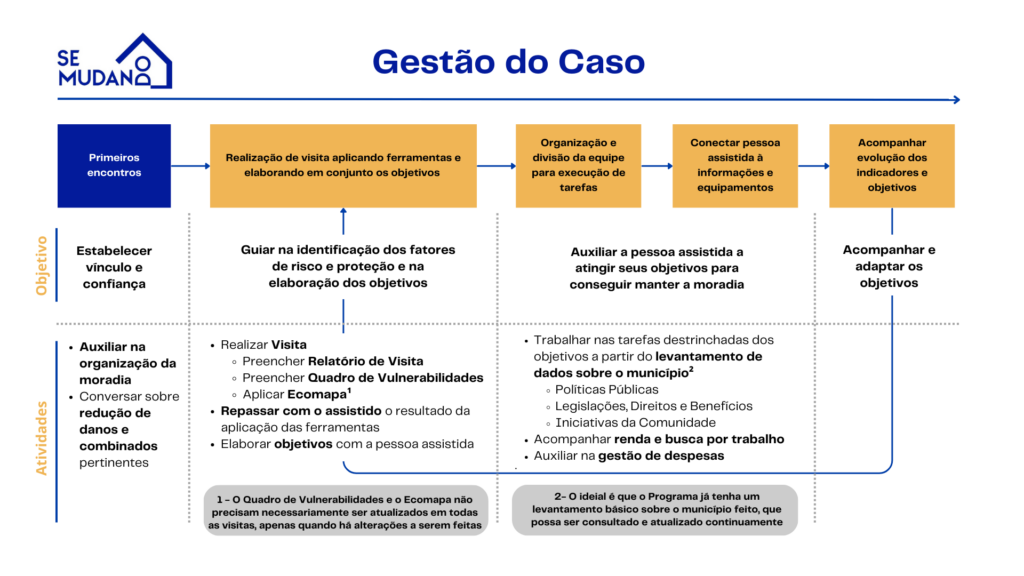
The first meetings are essential to establish a relationship of trust with the assisted person. Keep in mind that she has just moved into a new home, so the first visit should be to organize the dwelling. As for market purchases, at first we monitor the assisted person to help them analyze how much money they have and how to spend it (choose priorities).
This is also the moment when we pass on the Institute's vision of drug addiction, harm reduction and the Housing First methodology. Thus, we strengthen combined and improve the bond with the assisted person, differentiating our way of working from traditional bias. It is also important to remember that we are there to assist them, but that all the decision and progress in the programme depends entirely on them.
Thus, we begin the continuous process of case management. This consists in conducting periodic visits where we apply the case management tools and develop objectives with the assisted person. These are the objectives that become action plans to be followed in the visits. We also conducted the follow-up regarding a search for stable income and expenditure management. In the first few months, we make weekly visits, but during the course of the case, we can combine another frequency with the assisted person.
Documentation
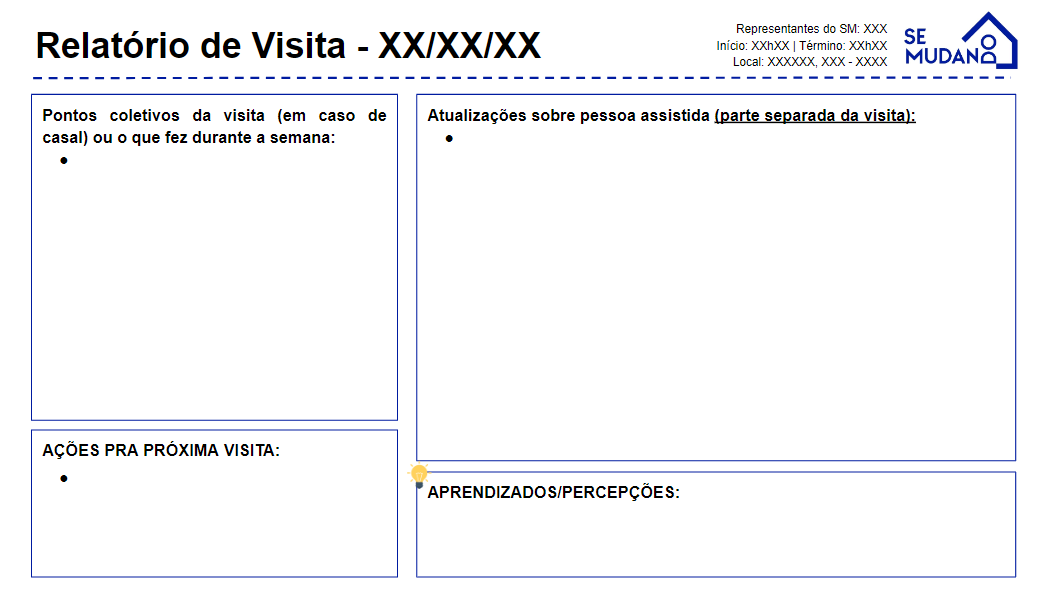
It is essential to draw up a report after each visit to ensure documentation on the progress of the case. We use this document as the basis for discussions on cases and filled in the following model:
We also use two case management tools. The first is the Vulnerability Framework to identify the risk and protection factors of the assisted person. The second is Ecomap, to map the social support network of the assisted person.
It is from these tools that we can identify the possible barriers of the assisted person to manage to maintain the housing and its strengths that can be worked to break the identified barriers. Objectives are then traced, necessarily together with the assisted person, from this information. Thus, we can unfold them into action plans for the person himself and the team. The team consisted of the monitoring agent and the case manager.
In practice, many of the action plans unfolded of the objectives involve connecting the assisted person to the information and equipment of the municipal health and care network. For example, CAPS AD (Centro de Atenção Psicossocial alcohol and other drugs) and CRAS (Centro de Referência de Assistência Social Reference Center for Social Assistance), so we have a survey of initiatives made on the municipality in which we work.
The survey takes into account legislation, rights, benefits, the public service network and private or voluntary initiatives. We can consult and update every case.
The main function of the team is to welcome the demands, support and create the necessary conditions for the assisted person to face the issues identified as barriers to maintaining their housing.
What's the final goal?
It is important to remember that in Housing First-based programs, it is essential not to work with deadlines and the frustrating logic of the repetitive process of renewing these deadlines. The information that the programme is permanent and that people will be able to rely on it indefinitely has an immediate safety psychological effect.
Case management is a continuous process and moments of crisis will be recurrent. Thus, the team should strengthen and have moments of discussion, in-depth study of cases and (re)development of strategies. Always take into account the will of the assisted person and a clear process of agreement.
We consider it a success to feel ready to go back to work, make new friends, and restore family relationships. But above all, we consider it a success every day that a person chooses to stay in his home.
The case closure process depends on the feeling of readiness of the assisted person. We started with the analysis of various indicators, such as income, social support network and the relationship with the use of substances.


Leave a comment